
A tissue paper dispenser is a wall-mounted washroom fixture that controls how paper is accessed and consumed in commercial spaces. It sounds like a small decision. In a hotel, hospital, or corporate facility handling 300 to 1000s users daily, depending on the traffic.
The wrong specification quietly costs more than it appears. A manual dispenser in a high-footfall washroom means unpredictable paper waste, reactive refilling, and a shared touch surface that works against the handwashing beside it. An automatic unit in a low-traffic corridor means paying for sensor technology a five-person office corridor doesn’t need.
Most facilities choose by price. The ones that choose by footfall, hygiene standard, and total cost of ownership get measurably better outcomes in consumption, in staffing time, and in the washroom experience guests and staff actually notice.
This guide breaks down both types across cost structure, hygiene performance, and real-world ROI.
What Is a Manual Tissue Paper Dispenser and How Does It Work?
A manual tissue paper dispenser operates on direct user interaction. Pull the lever, fold feeds. Press the mechanism, sheet advances. No power source, no sensor, no motor dependency. The entire value of this format lies in its mechanical simplicity, nothing complex to fail, nothing technical to service, and no battery cycle to track.
But that simplicity hands full control to the user. And user behaviour in a shared public washroom is unpredictable by default. Studies on controlled dispensing in commercial environments show manual systems generate 20 to 40% more paper waste per use than output-controlled alternatives. Most users take more than the task needs.
Types of Manual Tissue Dispensers Used in Commercial Spaces
Multifold and C-fold dispensers are wall-mounted, one sheet per correct pull, suited to low to medium-traffic offices and corporate washrooms where usage is predictable and footfall stays under 150 – 450 daily users per unit.
Centre-pull roll dispensers higher capacity format, designed so users touch only the sheet being pulled rather than the remaining stock. A better hygiene option within the manual category for mid-volume settings like schools and retail.
Jumbo roll manual dispensers high-capacity single roll format used in moderate-traffic public washrooms. Reduces refill frequency without moving to sensor operation.
What Is an Automatic Tissue Paper Dispenser and Where Does It Perform Best?
An automatic tissue paper dispenser uses an infrared sensor to detect hand presence and release a pre-set sheet length per activation. The user gets what the system decides consistent output, every cycle, regardless of footfall volume. No contact with the dispenser housing. No user decision-making. No variation between the first visitor of the day and the five-hundredth.
That consistency is the product and the operational predictability that follows it.
Types of Automatic Tissue Dispensers for High-Traffic Applications
HRT (High-Capacity Roll) automatic dispensers sensor-controlled, 1000+ sheet capacity, built for airports, malls, hospitals, and institutions where refill downtime is not acceptable and footfall is continuous.
Roll based Automatic Dispenser Uses Tissue Paper Roll to Dispense the Adequate level of paper in each use for better cost savings and environment friendliness.
Manual vs Automatic Tissue Paper Dispenser: Side-by-Side Comparison
| Factor | Manual Tissue Dispenser | Automatic Tissue Dispenser |
| Upfront unit cost | Lower | Affordable |
| Paper consumption per use | Variable, 20-40% higher on average | Controlled, consistent per cycle |
| Cross-contamination risk | Moderate shared touch surface | Low / zero contact during use |
| Staff refill predictability | Reactive, usage-dependent | Consistent, plannable by volume |
| Maintenance requirement | Minimal mechanical only | Battery or power checks required |
| Ideal footfall per day | Under 150 users per unit | 150 to 600+ users per unit |
| ROI recovery timeline | Lower upfront, higher running cost | Varies On the Footfall Traffic |
How Does a Tissue Paper Dispenser Impact Hygiene in Commercial Washrooms?
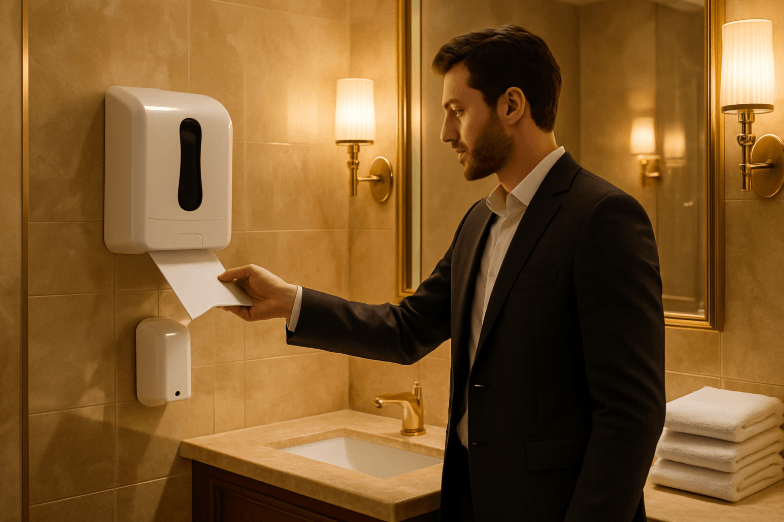
A manual tissue paper dispenser introduces a shared contact surface every user touches usually immediately after washing hands. That’s a cross-contamination point working directly against the handwashing it’s supposed to complete.
Automatic dispensers remove that contact entirely. Sensor activation means the unit is never physically touched during normal use, which aligns with infection control protocols in healthcare, food service, and premium hospitality settings.
Manual systems let users under-pull and leave with damp hands. Wet hands transfer significantly more bacteria to surfaces than dry ones. Controlled dispensing ensures adequate sheet length making the tissue paper dispenser an active part of the hygiene chain, not just the final step.
Application Areas: Which Type of Tissue Dispenser Fits Which Commercial Space?
Hotels and premium hospitality washrooms. Automatic dispensers in all guest-facing areas. The tissue paper dispenser specification should match the hygiene standard of the facility. Manual units work in back-of-house areas where footfall is lower.
Hospitals, clinics, and healthcare facilities. Automatic, without exception. Touchless operation isn’t a premium feature in clinical environments, it’s an infection control baseline. HRT automatic dispensers handle volume; recessed formats handle the hygiene protocol.
Corporate offices and business parks. Since The Business Parks and Corporate offices cater to high traffic crowd, an automatic paper dispenser is a perfect fit for that, wherease Under 100 daily users a centre-pull manual dispenser works well. Above that, an automatic unit pays back through reduced paper consumption within two years.
Airports, transit hubs, malls, and public institutions. High-capacity HRT automatic dispensers. Controlled output cuts consumption, and touchless operation manages the hygiene load that volume creates.
See also: Top Bathroom Renovation Ideas to Boost Comfort and Home Value
ABS Plastic vs Stainless Steel: Which Housing Material Should You Specify?
ABS plastic dispensers are lightweight, corrosion-resistant, and suited to standard commercial environments. Stainless steel housings handle high-frequency mechanical wear better across a five to ten-year lifecycle and are the standard for healthcare and hospitality where durability and appearance both matter. For high-footfall washrooms, stainless steel delivers better cost-per-year-of-service despite the higher upfront price.
The Decision That Matches Specification to Environment
Manual tissue paper dispensers aren’t the wrong choice. They’re the wrong choice for the wrong environment. In a low-traffic executive washroom, a manual unit is entirely adequate. In a 600-user-per-day airport terminal, that same unit creates reactive refilling, unpredictable consumption, and a contact surface undermining the handwashing beside it.
Automatic dispensers cost more upfront. They return that cost through consumption savings, predictable labour, and consistent hygiene in that order, across every commercial environment where volume and hygiene standards are non-negotiable.