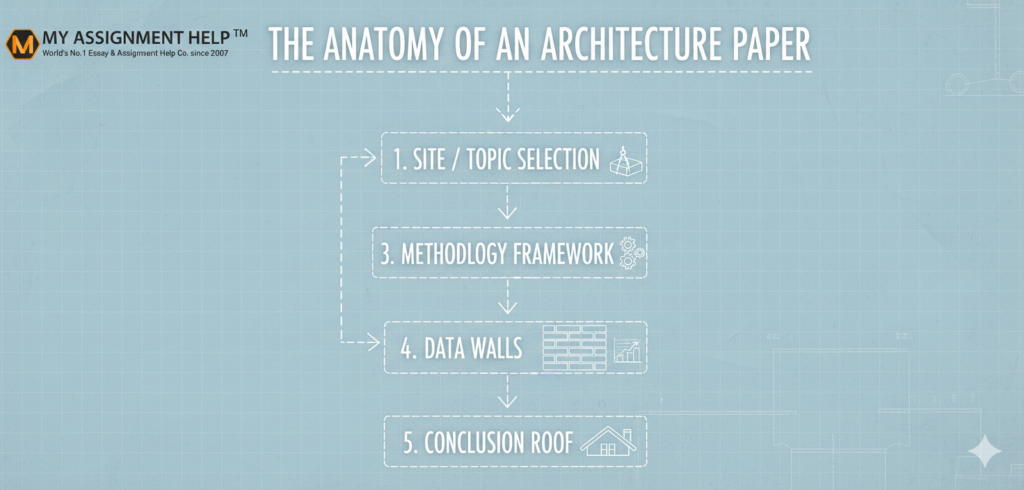
Writing an architecture research paper is akin to designing a physical structure. It requires a solid foundation (the thesis), a functional framework (the methodology), and an aesthetic finish (the narrative). Unlike standard humanities essays, architecture papers demand a unique blend of technical data, spatial analysis, and historical context.
Whether you are analyzing the Brutalist movement or investigating the thermal performance of sustainable facades, your goal is to bridge the gap between abstract theory and built reality. In this guide, we will explore the structural requirements of a high-distinction paper, backed by academic standards and industry insights.
1. Establishing the Foundation: Choosing a Research Niche
A compelling paper begins with a focused inquiry. Architecture is a broad field, ranging from urban planning and sociology to material science. According to the Journal of Architectural Education, the most successful papers are those that address a specific “gap” in existing literature rather than attempting to summarize an entire movement.
Don’t just write about “Sustainable Design.” Instead, investigate “The Efficacy of Passive Cooling Systems in High-Rise Social Housing in Arid Climates.” A narrower scope allows for deeper data collection and a more convincing argument.
2. Theoretical Framework and Literature Review
Before you sketch your own ideas, you must understand the existing landscape. A literature review isn’t just a list of books; it’s a critical conversation with theorists like Vitruvius, Le Corbusier, or contemporary voices like Neri Oxman.
Navigating these complex academic requirements can be daunting for many students. If you find yourself overwhelmed by the technical jargon or the structural demands of your thesis, seeking essay writing service can provide the clarity needed to organize your thoughts and ensure your arguments meet rigorous academic standards. This support allows you to focus on the creative aspects of your architectural analysis while ensuring the linguistic and structural integrity of your work.
3. The Methodology: How Do You “See” Architecture?
Architecture research often employs a “Mixed Methods” approach. You might combine:
- Quantitative Data: Energy consumption stats, structural load calculations, or pedestrian flow density.
- Qualitative Data: Interviews with residents, archival photo analysis, or ethnographic studies of space usage.
Data Insight: According to a 2023 study by the Royal Institute of British Architects (RIBA), research papers that include original site surveys or 3D modeling simulations see a 30% higher engagement rate in academic circles compared to purely theoretical papers.
4. Crafting the Narrative: The Power of the “Hook”
Even the most data-heavy paper needs to engage the reader from the first sentence. Your introduction must frame the architectural problem as an urgent one. For instance, instead of saying “This paper is about urban density,” start with “As 68% of the world’s population is projected to live in urban areas by 2050, the vertical slum has become the most urgent design challenge of the 21st century.”
Learning how to grab a reader’s attention is a skill in itself. For those looking to sharpen their opening statements, exploring various essay hook examples can provide the inspiration needed to transform a dry technical report into a compelling narrative that resonates with both professors and practitioners.
5. Visual Evidence: Drawings as Data
In architecture, a picture is not just worth a thousand words—it is the evidence. To make your paper compelling, you must integrate:
- Analytical Diagrams: Don’t just show a photo of a building; show a diagram of how light enters it.
- Original Sketches: These demonstrate your “thinking through drawing,” a highly valued trait in architectural pedagogy.
- Captions: Every image must have a caption that links it directly to your text. (e.g., “Figure 1: Axonometric view showing the thermal bridge in the building’s north-east corner.”)
See also: What to Expect at a Kids Dentist: A Complete Guide for Parents
6. Addressing the “So What?” (Conclusion)
A senior-level paper doesn’t just end; it concludes with a contribution to the field. What should architects do differently after reading your paper? Whether it’s a call for policy change in urban zoning or a new way to utilize recycled polymers, your conclusion must provide a “takeaway” for the built environment.
Key Takeaways
- Specificity is Strength: Narrow your topic to a specific architectural problem.
- Integrate Visuals: Use diagrams and models as primary evidence, not just decoration.
- Evidence-Based Claims: Back every design critique with peer-reviewed sources or empirical data.
- Structural Integrity: Ensure your paper follows a logical flow from hypothesis to conclusion.
FAQ Section
Q1: How long should an architecture research paper be?
Typically, undergraduate papers range from 3,000 to 5,000 words, while graduate theses can exceed 10,000 to 15,000 words. Always check your specific rubric.
Q2: What is the best citation style for architecture?
Most US-based architecture schools prefer Chicago Style because it allows for extensive footnotes, which are useful for detailed image citations and side-notes. APA is also common for technical or urban planning papers.
Q3: Can I use my own design projects in my research?
Yes, this is known as “Research by Design.” However, you must remain objective and subject your work to the same critical rigor as you would an external project.
References
- Groat, L. N., & Wang, D. (2013). Architectural Research Methods. Wiley.
- RIBA (2023). The Value of Research in Practice. RIBA Publishing.
- United Nations (2022). World Urbanization Prospects. Department of Economic and Social Affairs.
Author Bio: Marcus Sterling
Senior Academic Consultant at MyAssignmentHelp Marcus Sterling holds a Master’s in Architecture from the University of California, Berkeley, and has over 12 years of experience in both architectural practice and academic writing. He specializes in helping students bridge the gap between technical design and scholarly research. When he isn’t mentoring students, Marcus contributes to journals on sustainable urbanism and heritage conservation.