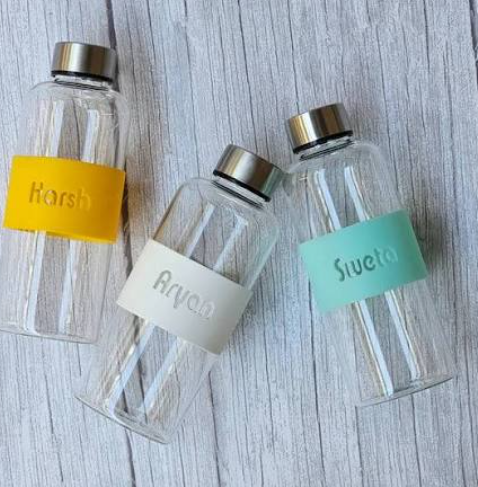

There’s glass, and then there’s borosilicate glass. No one knows until there’s a problem, and at that point, the damage is done – they’ve already gotten themselves the wrong bottle. The difference between ordinary glass and borosilicate glass isn’t superficial. It cuts right into the chemical makeup, the behavior at heat, and every safety aspect of the bottle you hold daily against your mouth. Definitely worth knowing about correctly, and not just treating all glass like glass.
What Happens Inside Regular Glass When Temperature Changes
Heat makes things expand. Glass included. That is not a problem on its own. The problem is when different parts of the same glass bottle expand at different speeds.
Pour something hot into a cold standard glass and the inner surface heats up before the outer surface does. One part tries to expand while the other has not caught up yet. That tension travels through the structure. Sometimes the glass cracks outright. Sometimes it develops damage too small to see that accumulates quietly over repeated use until the bottle fails at a moment that feels random but was not.
Borosilicate glass sidesteps this entirely. Boron trioxide in the composition brings the thermal expansion rate so low that hot and cold barely register as competing forces within the material. Minus twenty to one hundred and fifty degrees Celsius is the safe operational range. Standard soda-lime glass manages minus ten to eighty. That is not a minor spec sheet difference. It is the reason one glass bottle handles morning tea from the kettle, and one does not.
Plastic Is Doing Something Your Glass Bottle Does Not
Research published in 2024 found hundreds of thousands of nanoplastic particles inside a single litre of standard bottled water. The water was not contaminated. The container was just behaving normally.
Plastic leaches. The compounds inside the bottle wall migrate into whatever liquid sits against them, and warmth accelerates the process. BPA attracted the first serious regulatory attention. Manufacturers reformulated. Studies found that several of the replacement compounds behave similarly at a hormonal level. The name on the label changed. The migration did not stop.
Borosilicate glass does none of this. Non-porous surface, stable chemistry, no reaction with acidic drinks including coffee, citrus water, or anything fermented. The drink inside tastes like itself because nothing from the container is getting into it. That holds after a week of use and after three years of daily use in equal measure. Plastic cannot say the same thing.
The Boron Question and What Is Actually In the Composition
Some people read borosilicate and pause on the boron. Reasonable, but the concern does not hold up.
Boron inside borosilicate glass is locked within the silica matrix. It does not float free into liquid. It does not migrate under normal temperature conditions. Regulatory food safety classifications globally treat glass as an inert contact material specifically because of this behaviour, and borosilicate has held that status since the late nineteenth century when Otto Schott first developed it for laboratory use. Scientists needed a container that would not interfere with what was inside. Borosilicate was the answer then and remains the answer now.
No lead either. No cadmium. No BPA. For anyone who started looking at their plastic bottle differently after the microplastics research, a well-made glass bottle in borosilicate is where the safety case actually holds when examined rather than assumed.
The Durability Conversation
Right, it is glass. Drops happen and glass breaks. That is honest and worth acknowledging.
But the ways borosilicate fails are more predictable and less insidious than regular glass. It does not develop hairline cracks from dishwasher cycles. It does not weaken gradually from thermal stress. It does not scratch into a surface that harbours residue over time. When it breaks, it breaks. Until that point, it stays structurally consistent in a way regular glass does not across the same period of daily use.
Most glass bottles in this material come sleeved in silicone, which handles everyday drop scenarios without adding meaningful weight. The glass itself runs about fifteen to twenty percent lighter than standard glass of the same dimensions. Heavier than plastic still. But not as heavy as most people expect the first time they pick one up.
See also: Why Global Businesses Prefer App Developers India for Digital Transformation
Conclusion
Borosilicate glass holds up because the material properties are genuinely suited to daily hydration use. Thermal stability across both hot and cold without structural stress. Chemical inertness that keeps the drink clean regardless of what it contains or how long it sits there. An absence of the compounds that make plastic a documented concern rather than a theoretical one. Not indestructible, not cheap, but safe in the ways that actually matter for something you use every single day.