
As such, when strong winds hit a house, any little weakness on the roof is bound to cause serious destruction. The flow of the wind on the roof and above causes wind uplift that focuses on points such as the edges of the shingles, the eaves, and the ridges. Three-tab asphalt shingles are particularly bad in dealing with this pressure, as they are light, single-ply, and susceptible to wind intrusion.
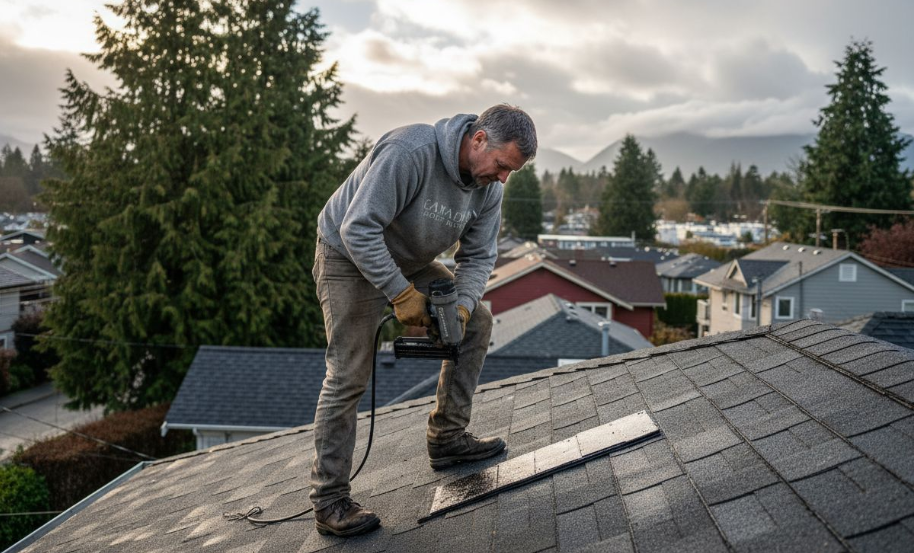
Architectural shingles work in a different way. They weigh more, have several layers, and use tough nail zones and glues so they stay put even in rough weather. The only way to really know if your roof can stand up to winds from a big hurricane—up to 130–150 mph—is to check the shingle’s wind rating. Look for ASTM D3161 Class F or ASTM D7158 Class H ratings. If you work with a team like Seam Roofing, you get high-wind shingles put on with the right six-nail pattern and strong starter strips. That’s what the shingles need to meet the wind ratings on the box. If you skip these steps, the number on the packaging doesn’t mean much.
How Wind Actually Damages a Shingle Roof
Wind damage does not hit a whole roof the same way. The wind often starts at the edges of the roof. This is because wind speed gets higher when air moves up and over a building.
Wind Direction —> [High Uplift Suction Zone]
/ \
/ \ <— Peel Back Risks at Eaves & Ridges
/ \
[Building Structure]
1. Tabs Catch Wind and Start Peeling
When wind gets under an old or loose tab, it pushes air under the shingle. This can lift the shingle. The shingle might bend back, and sometimes the center part breaks. In other cases, it may pull away from what holds it down.
2. Nails Pull Straight Through
If the wind blows strongly, the shingle gets lifted while the nail stays inside the plywood beneath. When the shingle has no strong part where nails can go in, then it could get torn off and leave an opening to see the underlayment underneath.
See also: Expert Guide to House Raising Services and Benefits in Brisbane for Flood Protection and Extra Space
Understanding Wind Ratings and Interlocking Technology
Manufacturers no longer count on just how heavy the asphalt is to keep shingles in place during storms. High-wind systems get their strength in two ways. They use better locks to hold things down. The glue used has also been tested to work and has a certificate to show it.
ASTM Wind Testing Standards
| ASTM Standard | Test Method | High-Wind Passing Class | Wind Speed Threshold |
| ASTM D3161 | Fan-Induced Air Stream Test | Class F | Tested up to 110 mph continuous blow |
| ASTM D7158 | Uplift Force / Resistance Calculation | Class H | Resists uplift forces generated up to 150 mph |
How Interlocking and Adhesives Actually Help
- Reinforced Nailing Fabric: A strong woven fabric piece in the nailing part helps keep the nail heads in place. This stops them from pulling through when shingles get stressed.
- Thermoplastic Sealant Strips: They are adhesive strips activated by the sun’s heat. These strips hold together all the different layers of shingles and hence form a solid roof surface rather than individual parts.
- Interlocking Tabs: Some of the tile-style and hybrid shingles feature a lip and groove design that allows the shingles to lock into one another and hence do not have any loose edges to be lifted by the wind.
Conclusion
A durable roof in a storm does not necessarily come from using the right type of shingles. It involves the use of quality materials and the proper installation according to the manufacturer’s specifications. It is best to get shingles that are made for ASTM D7158 Class H. This way, you get a good chance that your roof will hold up against strong winds. The sticky strips and tabs lock together to keep water out after the wind blows hard. If you use a trusted contractor like Seam Roofing, you know they will put in every starter strip, ridge cap, and nail in the right way. This way, your roof works how it should, and your house stays safe for years.